
The Southwest Partnership
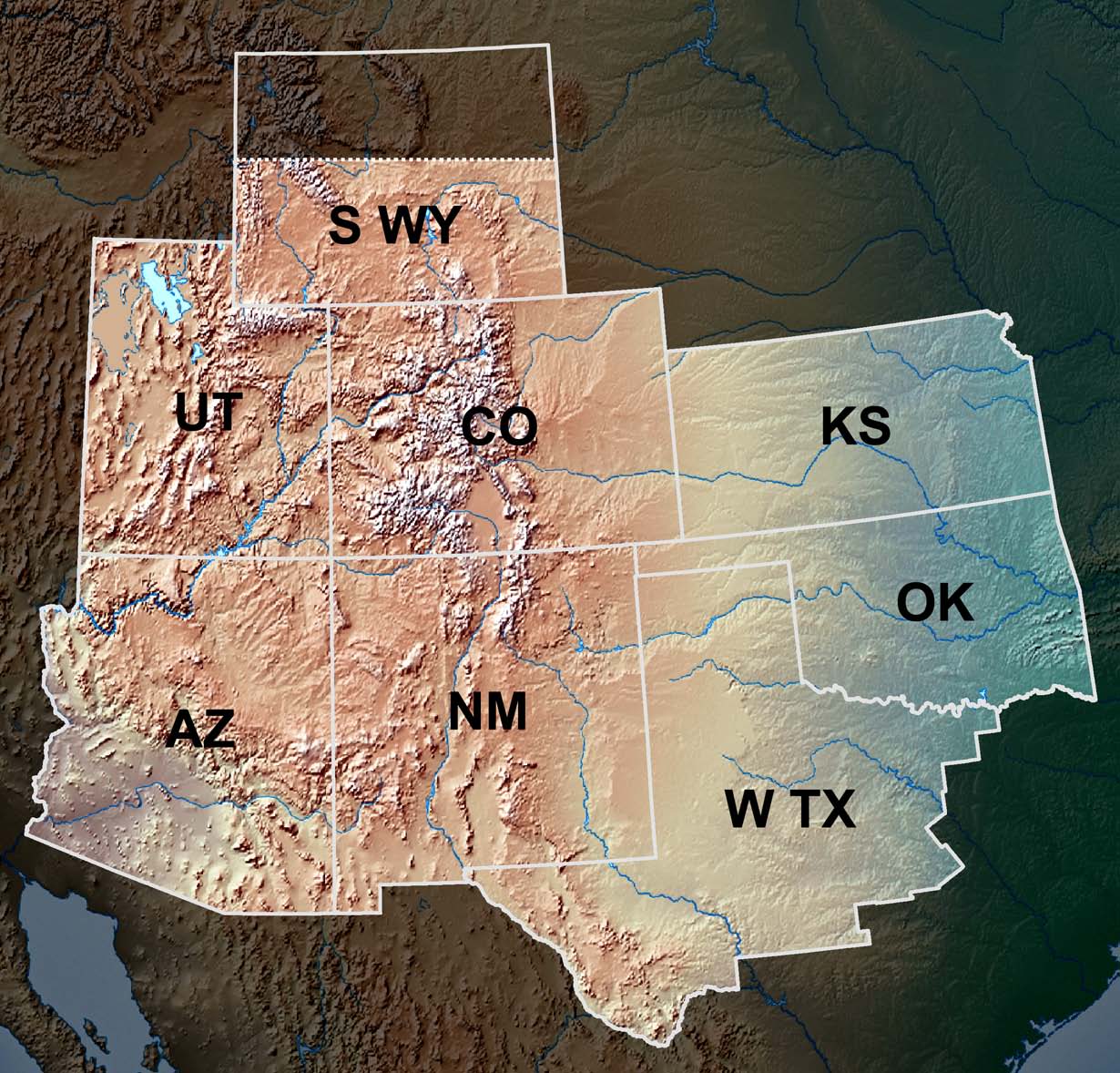 The Southwest Regional Partnership on Carbon Sequestration (SWP) is one of seven regional partnerships established in 2003 by the US DOE to study carbon management strategies. Since the creation of the partnership SWP has completed a number of studies (Phase I, Phase II), but our most exciting work has been the Phase III study now underway at Farnsworth Oil Field.
At the onset of the project, SWP worked in close partnership with the previous field operator, Chaparral Energy LLC, an industrial partner that was engaged in an Enhanced Oil Recovery (EOR) project in Farnsworth Oil Field (FWU) in the northeast Texas panhandle. Ownership of the field has changed since we began in 2013, but the project continues. The EOR project is using CO2 captured from an ethanol and a fertilizer plant to increase the oil recovery from this mature field. SWP’s role is characterization of the field, monitoring the surface and subsurface for evidence of any change in the background level of CO2, and modeling the results of the EOR effort.
The initial part of the Phase III project was to establish baselines for monitoring efforts, and to thoroughly characterize the reservoir and caprock using a large range of disciplines and techniques. In the course of this project, SWP has collected a tremendous amount of information from FWU that has allowed us to build a detailed model of the field for simulation of oil recovery and CO2 movement through the reservoir. SWP has also installed a variety of monitoring networks and run several tests to help validate the models and monitor the effectiveness of the injection and storage operations. At FWU, CO2 injection has been demonstrated to be an economically advantageous way of producing more oil from a mature field and storing anthropogenic CO2 that is a byproduct of other industrial processes.